
Finding Confidence, Community, and a Future in Music: Esther Benjamin Reflects on the Hartford Symphony Fellowship
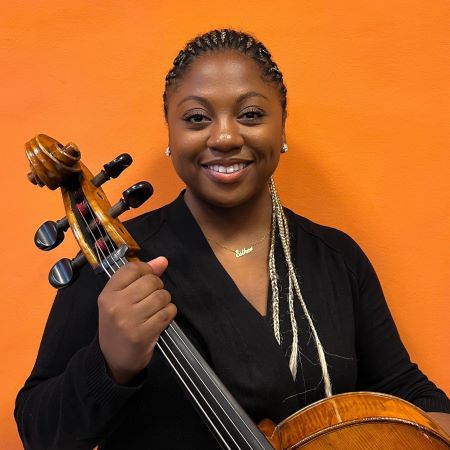
When cellist Esther Benjamin looks back on the beginning of her Hartford Symphony Orchestra Fellowship, the most significant change has been her confidence as a musician.
Before joining the program, Benjamin had just completed her first year as a doctoral student at The Hartt School and was still relatively new to Connecticut. Much of her time had been spent teaching, a role she continues to value deeply. Yet she admits that she carried doubts about whether she truly belonged in a professional orchestral environment.
“I had reservations about whether I was really cut out for performing or being part of an orchestra,” she recalls. “When I won the fellowship audition, I was ecstatic, but I also wasn’t entirely sure what to expect.”
Over the course of two years, those doubts gradually gave way to confidence. Through rehearsals, performances, educational initiatives, and community engagement programs, Benjamin discovered not only that she could succeed in a professional orchestra, but that she belonged there.
“The fellowship affirmed that I could do this,” she says. “It showed me that I was capable of growing into a role in a professional organization and contributing at a high level.”
Her journey to that realization was not a traditional one. Benjamin began playing cello at age ten and did not study with a private teacher until several years later. She attended a small liberal arts college with a small music department before pursuing graduate studies in the Northeast.
“I came from a very unconventional musical background,” she explains. “I wasn’t always sure I could see myself in these spaces. The fellowship helped me realize that someone like me could be successful in a professional orchestra.”
One of the moments that crystallized the fellowship’s impact came during her first Hartford Symphony Masterworks series. Much of the repertoire was entirely new to her, and the pace and expectations of a professional orchestra proved demanding.
“Every cycle felt like starting from scratch,” she says. “The expectations were higher, the pace was faster, and the margin for error was smaller. It was challenging, but it was also the moment I realized I could rise to that challenge.”
As the fellowship progressed, Benjamin found herself successfully navigating new conductors, artistic approaches, and performance expectations. Those experiences taught her that versatility is one of the most important qualities a professional musician can develop.
“I could look back and see that I was growing,” she says. “I was becoming more adaptable, more confident, and more professional through the experience.”
“There were countless moments of wisdom, advice, and encouragement that helped me grow.”
Equally transformative were the relationships she built with Hartford Symphony musicians. While freelance performances and short-term engagements can provide valuable experience, the fellowship offered something different: sustained mentorship and a supportive community of colleagues invested in her success.
“So many musicians reached out, encouraged me, checked in on how I was doing, and offered feedback,” Benjamin says. “There were countless moments of wisdom, advice, and encouragement that helped me grow.”
Those relationships extended beyond the concert hall. Through educational and community programs, Benjamin was able to combine her passion for teaching with her work as a performer, using her experience as an educator to connect with students and introduce them to music.
“I love finding ways to relate to young people and inspire them with music they may know and music they may not know,” she says. “Being able to do both teaching and performing has been incredibly meaningful.”
The fellowship has also reshaped her vision for the future. While Benjamin still hopes to pursue a career as a performer, she now sees a broader range of possibilities than she once imagined.
“I’d love to be a professor someday, and I’d also love to continue performing and auditioning for professional orchestras,” she says. “The fellowship has helped me see that those goals are possible.”
Perhaps most importantly, the experience has changed the way she views opportunity itself. Success in music, she notes, is rarely a straight path. Auditions do not always work out, and careers are built through persistence, preparation, and resilience.
“The fellowship taught me that just because something is difficult doesn’t mean you’re not capable of it,” she says. “It’s given me confidence to pursue opportunities that I might have been too hesitant to pursue before.”
“Your support helps people see more for themselves. It helps talented musicians grow into the artists they want to become.”
For donors and supporters, Benjamin’s message is simple: your investment changes lives.
“The opportunity exists because of donor support,” she says. “For people like me—people who have the determination, the talent, and the drive, but may not have had the same opportunities—programs like this make all the difference.”
She hopes supporters understand that their contributions do more than fund performances or educational activities. They create pathways for emerging musicians to develop professionally, gain confidence, build relationships, and imagine futures that once seemed out of reach.
“Your support helps people see more for themselves,” Benjamin says. “It helps talented musicians grow into the artists they want to become. I’m a testament to the impact that opportunity can have.”
As Hartford Symphony welcomes new fellows in the years ahead, Benjamin’s experience stands as a powerful reminder that investing in emerging artists is ultimately an investment in the future of orchestral music itself.